Hanna Eliise Kitter and Saskia Krautman discuss with Elke Krasny why we need a critical care lens in architecture.
Elke Krasny works with the topic of care, which has only recently been introduced to the field of architecture. In her work as a researcher, curator, cultural theorist, and author—reflected in the exhibition and publication Critical Care: Architecture and Urbanism for a Broken Planet (MIT Press, 2019) and in the group Ecologies of Care, co-initiated with Urska Jurman—Krasny proposes that architecture can be a means of supporting the right to care. Therefore, architecture could be reimagined as a form of care—a foresight that echoes the much-needed grounding of architecture and architects in the urgent needs of our planet and its species. After a brief conversation in Tallinn, we had the opportunity to discuss in greater depth Elke’s stance on the kinds of value systems that lay the groundwork for practicing with care in architecture.
Hanna Eliise Kitter (HEK), Saskia Krautman (SK): In your work as a theorist, curator, and professor at the Academy of Fine Arts Vienna, you have been working with questions of care for close to fifteen years now.
Elke Krasny (EK): I am interested in how the notion of ‘care’ brings together all the labours necessary for social and environmental reproduction—that is, everything that needs to be done to create the bodily and material basis for being able to exist. At the same time, care speaks to the ethical dimensions of the relations created, sustained, and cultivated. And care is about the responsibility—and response-ability, to use Donna Haraway’s term—towards these relations, as these relations emerge from and are sustained by labours of care.
HEK, SK: Could you expand on how you see and define care in the context of architecture?
EK: It is important to consider that, whether made explicitly a part of the study of architecture or the process of designing it, care has always been shaped—i.e., spatialised—by architecture. Yet only quite recently has the lens of care been brought into the understanding of architecture, and my own work, in particular the book and exhibition Critical Care: Architecture and Urbanism for a Broken Planet, together with Angelika Fitz, is an active contribution to using care as a critical lens for understanding what architecture does and how architecture supports, in spatial and material terms, the rights to care and the freedom to care.
Care has always been shaped—i.e., spatialised—by architecture.
My focus and interest lie in how architecture can be a form of critical—i.e., indispensable—care, and, simultaneously, how critical care can be honed as a perspective for understanding architecture more generally. Critical care can serve as a lens through which to rethink architecture in its many forms and dimensions, helping to reimagine architecture in ways that foreground care, attention, and responsibility. By considering architecture through the lens of critical care, one can study and understand both its potential to nurture and sustain, as well as its capacity to harm and do violence. Through architecture—most broadly understood as all kinds of buildings, not just architecture with capital A—human beings quite literally inhabit the planet. Architecture is planetary inhabitation. Buildings have played a large part in shaping the state of the planet, which now stands on the brink of collapse, characterised by environmental degradation and climate breakdown.
HEK, SK: Your analysis relates architecture to the planetary scale but simultaneously foregrounds its impact on shaping our everyday spaces.
EK: Buildings shape how human beings are housed—that is, how the spaces in which they take care of themselves and their everyday needs are organised, providing the conditions for care. Buildings also define and shape how bodies and minds with diverse abilities and health conditions experience care and can be cared for. Connecting the concept of critical care to scales of care allows for a nuanced, situated, locally specific analysis of buildings—and the environments they build—in relation to planetary care.
Architecture is therefore not only implicated in the critical—i.e., catastrophic—state of the planet, but has also defined everyday routines and habits, as well as possibilities and cultural value systems of care. We may think here of how gendered hierarchies were produced and are still being reproduced by housing typologies, or how the notion of the nuclear family has defined modern domestic territories. We may also think of how architecture has the potential to create new blueprints for social reproduction that allow for queering gender hierarchies, for collective forms of kinship and new ecologies of care, and for dismantling the still pervasive dichotomy between the private and the public realms. Care in architecture—and architecture as care—connects bodies and minds across private and public realms, and extends to the scale of planetary inhabitation.
HEK, SK: How would you define the role of the contemporary architect? What kind of a worker is an architect?
EK: I do not think that there ever can be—or even should be—one singular definition of what an architect is and, perhaps even more importantly, what an architect does. What I do think, however, is that a large part of architectural production is driven by historically specific regimes of power and economies. Currently, we are witnessing how accelerating capitalism and lobbying by the construction industry are defining the conditions for architectural production at global and local scales. We could therefore conclude that architects have worked for state powers and the power of capital. Yet, it is also important to remember that there are quite different traditions—and therefore social and cultural imaginaries—of the role of the architect. At the risk of oversimplifying, one could observe that in the context of the former East, the architect was largely seen as a scientific professional who leads the way in building the new society. In the West, on the other hand, there is a long tradition of architecture as a liberal profession, very much linked to notions of the genius and creativity. Both of these traditions can be aligned with architecture being a master’s tool, an instrument of those in power.
Architects across generations who share a commitment to reclaim their practice from the grip of capital. They strive to ensure that design serves care, not profit.
I am interested in the histories of architecture, and for me, histories of architecture are also very much histories of our present historical moment, histories of the here-and-now that allow us to understand the many different resistant—disobedient, unruly, deviant—practices of architecture. There are, in fact, architects across generations who share a commitment to reclaim their practice from the grip of capital. They strive to ensure that design serves care, not profit. At the same time, they challenge deeply rooted cultural and social norms that shape how spaces are conceived and that perpetuate classed, gendered, and racialised social hierarchies. This dual effort reflects a vision of architecture that is both socially conscious and liberated—that is, caring.
HEK, SK: Historically, architecture has not been defined as a caring profession. A key concept in theories of care is interdependency, whereas a very important notion in the self-understanding of architects has been independence, even as they are in fact providing a service. What caused the historical separation of architecture and care? And can you imagine a different future for practising architecture?
EK: Let me begin with the broadest possible approach I can think of: we care, therefore we are. This, of course, invokes the Cartesian ‘Cogito ergo sum’—I think therefore I am—to raise awareness of the fact that Enlightenment modernity has resulted in not only splitting the mind from the body and culture from nature, but placing them in relations of hierarchy and domination. Architecture was central to expressing and giving material shape to this split. The architect, seen as a master-mind who defines and shapes how bodies exist in space, how humans inhabit the planet, and what form and shape this inhabitation takes, is very much aligned with the notion of contemplating—that is, imagining and designing—buildings that do not exist yet. The thinking of architects thus extends to mastering the time we call future—that which lies ahead of us. Currently, however, there is rising awareness that what lies ahead are broken futures.
At the same time, we can notice a certain turn in architecture, including architectural education, towards finding new ways of maintaining, repairing, fixing, restoring, and caring for already existing buildings, rather than building new ones. Architects are increasingly becoming carers of existing buildings. This has a number of different consequences for the social and cultural imaginaries of the profession. Maintaining something that already exists in order to ensure its continued existence is very much aligned with the notion of care. Taking care of what exists requires a different relation to the future, or to architecture as designing, than building and shaping the future through new buildings does.
Paradoxically, this requires not only finding new ways of caring for the materiality of buildings—as we now know the steel–glass–concrete construction paradigm to be disastrous for the planet—but also learning new ways for architecture to shape the inhabitation of existing buildings. Many, if not most, of the existing buildings we now have in the world have shaped agency and spatial power based on unequal classed, gendered, racialised, and speciesist hierarchies, particularly in relation to care. Maintaining the existing, yet making it possible to inhabit the existing in alternative ways has emerged as a new task for architecture, which very much demands—and foregrounds—care.
HEK, SK: Care has become a bit of a buzzword in architecture and beyond. How to make sure that it does not become instrumentalised as a tool for maintaining structures of power and control?
EK: We are witnessing a number of different developments in relation to care. Taken together, they are contradictory and antagonistic. We see how right-wing and authoritarian ideologies are condemning gender as ideology. This leads to the reinforcement of a compulsory binary order of two genders with each defined in such a way that the spaces of men and women in the world are being re-traditionalised. With it comes a form of ideological lifestyle and branding through hyperfeminisation and hypermasculinisation. In consequence, the architecture of the domestic territory, for example, becomes an Instagrammable backdrop for capitalist ‘tradwives’ who celebrate homemaking, child-rearing, and supporting their husbands. This has a lot to do with not only the individualisation of care—i.e., the opposite of collective forms of care and welfare—but also with the reinforcement of traditional gender roles as social ideology.
At the same time, we can witness how caring has been taken up by policy, in particular urban policy. In the context of Germany, for example, new guidelines for gender justice and gender-responsive urban development policy are based on the ideas of a fair, inclusive, and caring city. However, we still clearly note the absence of feminist or queer-feminist terminologies in these policies. Such careful avoidance of feminist thought and praxis is not accidental; it is structural.
Challenging power relations—including built power relations in architecture—continues to be a terrain for feminist struggle and for what I call care feminism. This approach includes practicing new forms of resistance against the re-traditionalisation of gender and the concomitant shaping of care by authoritarian ideologies, the rampant commodification of care, and the instrumentalisation or pacification of radical care through policies, while at the same time struggling to hold policies accountable for building spaces for care.
HANNA ELIISE KITTER and SASKIA KRAUTMAN are architecture students at the Estonian Academy of Arts, representatives of the Estonian Architects’ Association’s Youth Section, and members of the collective Kunstiryhmitus (Art Gr0up).
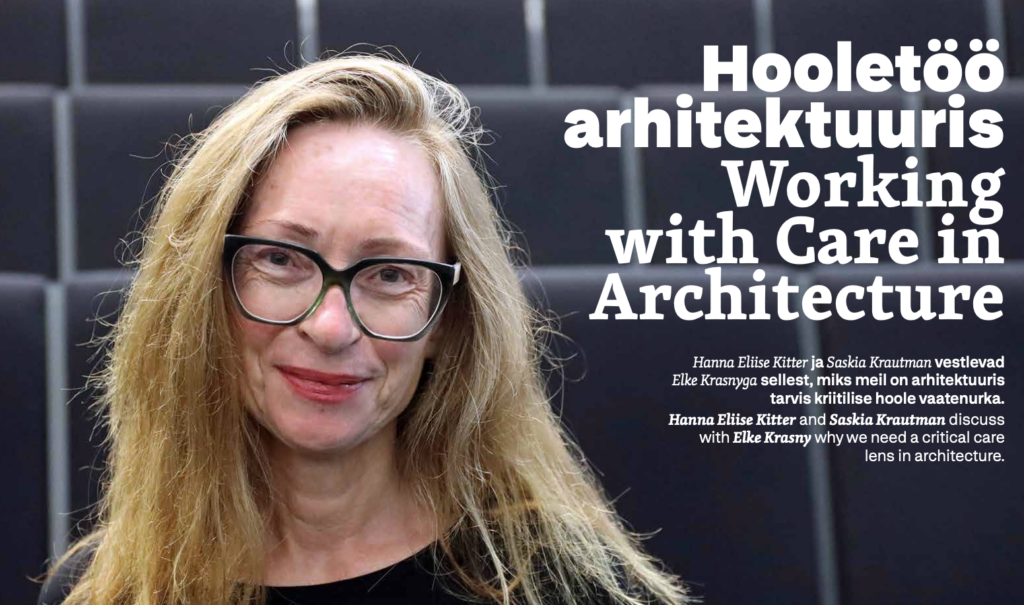
HEADER: article header in the magazine. Photo by Estonian Academy of Arts, Tiina Tammet, design by Unt/Tammik.
PUBLISHED: MAJA 3/4-2025 (121-122) with main topic WORK AND FOOD